



Making Time Usable
The calendar made time usable by turning it into a practical tool. It didn’t begin as an abstract idea, but as a response to real-world needs: coordinating activities, anticipating cycles, and creating a shared frame of reference.
From the earliest civilizations, this need was evident. Without a common way to track time, it was impossible to plan agriculture, manage trade, or organize social life. Over time, this system evolved into a stable structure, shaping the rhythm of days, months, and years in a way that people could collectively understand and rely on.

From Measurement to Organization
Over time, the calendar took on a broader role. It no longer simply marked dates, but began organizing different types of information in a coordinated way. Days of the week, months, recurring cycles—each element serves a specific function and must fit within a clear, readable structure. The calendar, then, is not just a sequence. It is a system.
 Portrait of Thomas Tompion, pioneer of modern watchmaking
The Calendar Enters Watchmaking
Watchmaking began to engage with the calendar once indicating time alone was no longer enough. Between the 17th and 18th centuries, the first watches featuring date displays appeared, initially through relatively simple solutions.
Among the early innovators were English watchmakers such as Thomas Tompion, often regarded as one of the fathers of modern horology, and later Thomas Mudge, who played a key role in developing more advanced mechanisms.
Over time, these indications expanded to include additional information such as the day of the week and the month. The goal was not complexity for its own sake, but the integration of multiple time references into a single, practical system.
 The Arsenal of Venice, the heart of the Serenissima’s naval production
Venice and the Logic of Systems
This need for organization becomes even more evident in complex environments. For centuries, Venice stood as one of the main commercial hubs of the Mediterranean. Its operation depended on the continuous and coordinated management of flows: goods arriving from different routes, people, information, and the precise timing of loading and unloading. In such a context, time could not be approximate. It had to be structured.
The Venetian Arsenal represents one of the most advanced expressions of this approach. It was not simply a shipyard, but a highly organized production system where every activity followed a defined sequence.
Shipbuilding adhered to a coordinated logic: processes were divided into distinct phases, each department intervened at a specific stage, and transitions between phases were continuous and controlled. This made it possible to manage complex processes efficiently and consistently. The Arsenal was not just a place of production, but a method, a concrete example of how complexity can be organized through structure, sequence, and coordination.

A Common Logic
The calendar and the Arsenal respond to the same underlying need: organizing complexity. In the calendar, different pieces of information coexist within a coherent structure. Days, weeks, and months are not isolated elements, but parts of a system that only functions when each component is integrated with the others.
At the Arsenal, the same principle is applied to production. Processes, materials, skills, and timing are precisely coordinated, ensuring continuity, efficiency, and repeatability. In both cases, what matters is not the presence of individual elements, but how they are organized. Sequence, logic, and coordination are what allow the system to function.
 Detail of a mechanical movement with perpetual calendar, highlighting its architectural complexity
Why Full Calendars Remain Rare
In contemporary watchmaking, the full calendar remains a relatively uncommon complication, often associated with higher-end segments. The reason is both technical and industrial. Integrating multiple indications—such as day, date, month, power reserve, and day-night cycle, requires a complex mechanical foundation capable of managing all this information reliably and continuously.
Within the Swiss landscape, few entry-level solutions are designed with this architecture from the ground up. To achieve similar configurations, additional modules developed by specialists such as Dubois Dépraz are often mounted on base movements. These are effective solutions, but they introduce additional complexity and significantly increase production costs, placing such watches in higher price segments. As a result, the full calendar remains relatively inaccessible.

Arsenale Calendario: Designing Time as a System
Arsenale Calendario emerges from these considerations. On one side, the parallel between the calendar and the Arsenal, both systems designed to organize complexity. On the other, the desire to translate this principle into a tangible object, consistent with the design language of the Arsenale collection.
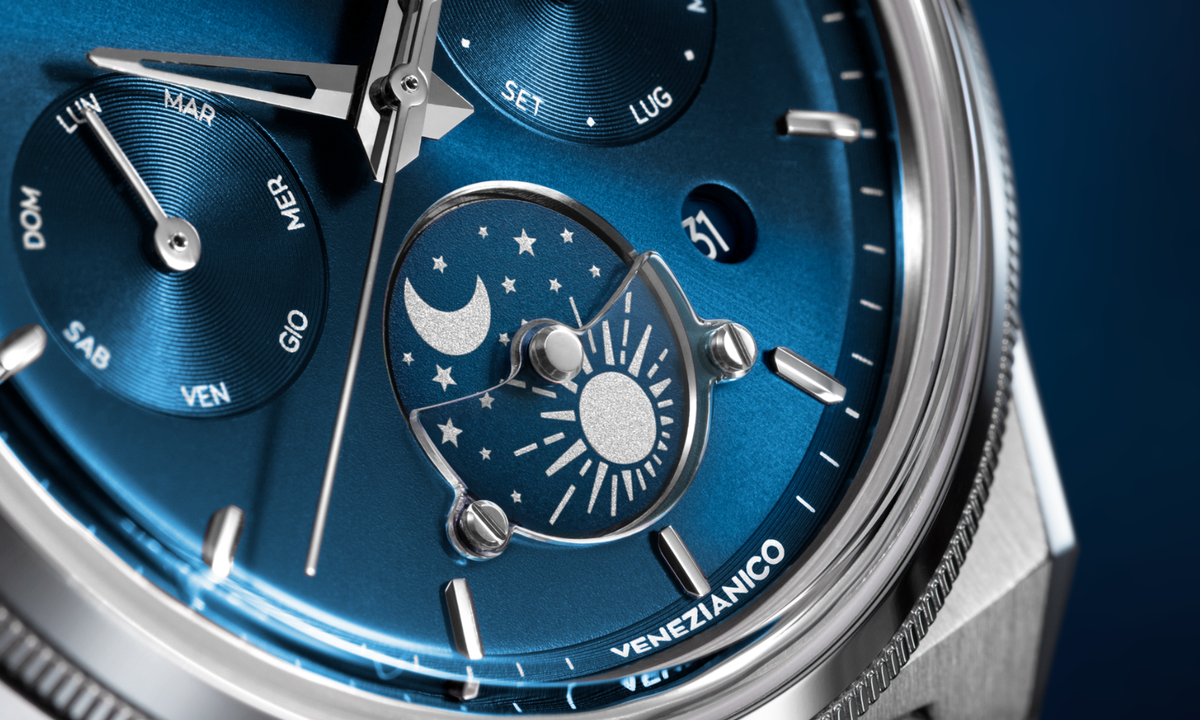
The next step was technical. After extensive research and a long selection process, the Miyota 9100 proved to be the most suitable caliber for this purpose: a high-frequency automatic movement, precise and reliable, capable of integrating a full calendar, power reserve, and day-night indication within a single architecture.
A solid yet sophisticated foundation, which required careful integration work. Some indications were refined to improve readability, such as replacing the 24-hour display with a more intuitive day-night disc, integrated into the dial through a sapphire semi-circle secured with two visible screws. At the same time, the remaining functions were distributed to maintain balance and clarity, avoiding visual overlap while preserving the essential character of the Arsenale design.
For more information on Arsenale Calendario, click the link.